
Ask an Arborist
Watering Your Trees
Your new urban shade tree will need to be watered for at least two years as it establishes a robust root system. Even after that, it will need help during periods of drought.

Water is Crucial
Arborists recommend watering young urban trees twice a week during the growing season for the first two years to establish a strong root system.
Volume
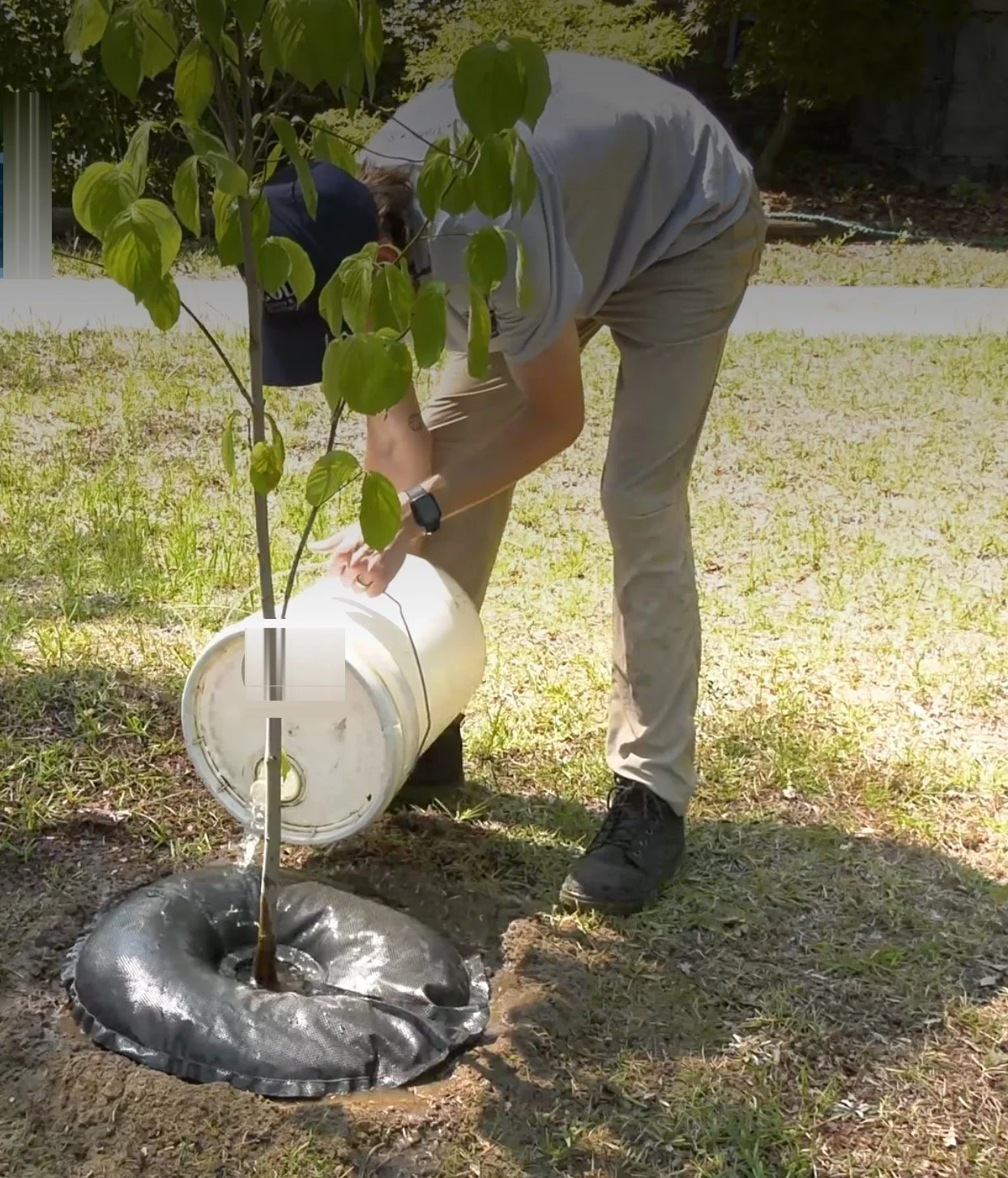
Depending on soil type and water delivery method, your (7 – 15-gallon) Beat the Heat or Trees for Campuses trees will require about 5 gallons of water a week during the first two years as they develop root systems necessary to draw water from deeper in the ground. Sandy soils may require more. When you water, be sure to also soak the TreeDiaper that came with your tree.
Frequency
Especially during the first summer when the weather is hot, we recommend watering more often than once a week, but check moisture levels so you don’t overwater. The TreeDiaper and the mulch you applied around your tree when you planted it will help to even out moisture levels between waterings. Reminder: the TreeDiaper is designed to absorb rainfall and the water you add and drip it slowly to the tree between waterings, and organic mulch helps to retain soil moisture and protect the soil from drying out too fast. But it will dry out!
How to Water
“Low and slow” is our best advice. Add water slowly to avoid runoff.
If you hand water with a hose, take your time, and use a shower head to distribute the water around the drip line of the tree, again, being sure to soak the TreeDiaper, which will slowly drip water into the soil over the next few days.
If you use a hose, leaving it running at a trickle is also a great option. To figure out how long to leave the hose in place, time how long it takes to fill a one-gallon container (like a milk jug) and multiply that by five. Set a timer so you don’t forget and cause a mess!
Another option is to drill holes in the bottom of a five gallon bucket, fill it with water, and leave it to slowly drain.
Better yet, install drip irrigation around the drip line of the tree.
Time of Day
Early morning and early evening are the best times to water. Try not to water in the heat of the day to avoid evaporation.
Tips
Avoid Overwatering: Too much water suffocates roots and causes yellowing or dropping leaves, similar to drought stress. Allow brief drying periods between waterings.
Expand the Zone: As the tree grows, move your watering point outward toward the drip line to encourage roots to spread.
Watering Area and Depth
Target the root zone. Water the area around the tree so water penetrates to the roots. Generally, this is at the drip line. Make sure water gets to 12” – 18” below the surface. The best way to determine this is with a moisture meter.
Ask an Arborist
FAQs about Watering Trees
-
This recommendation comes from the City of Columbia Forestry & Beautification’s practical experience. For 15 gal trees, this is a sufficient watering regimen, as you also need to count rainfall etc. in order to not overwater. (See soil types below)
Since Columbia Green is delivering 7 to 15 gallon trees this is more than sufficient for the first year.
-
This recommendation is for 7 - 15 gallon trees. For larger trees, you would definitely need to add more. Most recommendations are on caliper size. However, we usually go on planted pot size. For example, when we at the City plant 30 gal trees, we double the amount to 10 gal a week.
-
Low refers to water pressure: turn the water on low, and slow refers to delivering the water slowly rather than all at once. This gives the water time to soak deep into the soil and not run off into the area around the tree.
-
Sandy soils have a low water-holding capacity (roughly 0.4 to 0.8 inches of water per foot of soil).
Sand has large particles and large macro-pores. Water drains through it quickly via gravity, meaning it does not retain much moisture, so trees planted in sandy soil require more frequent watering.
Clay soils have a high total water-holding capacity (roughly 1.6 to 2.5 inches of water per foot of soil).
Clay has microscopic particles and tiny, tight pores. It holds a large volume of water, but much of that water is bound so tightly to the soil particles that plant roots cannot easily extract it (high wilting point). Water also infiltrates clay very slowly, which can cause surface runoff.
It is important with both soil types to add organic materials to allow the soil to better hold water and make it available to the tree.
-
An easy way to make sure you are watering correctly is to purchase a moisture meter. You can get a two pack at amazon for $10.
-
If you want to find out about the ph and nutrients in your soil, you can have it tested at Clemson Extension Service.
If you want to find out how much sand/loam/clay you have, you can follow these instructions from Clemson Extension to do a jar test at home.